
Cost guide
How Much Does It Cost to Build an RV Park?
This is the first question nearly every new developer asks, and the honest answer is that per-site cost is an output, not an input. What determines it is the site itself. Below is how an experienced planner reads a piece of land for cost before a budget is written.
The short answer
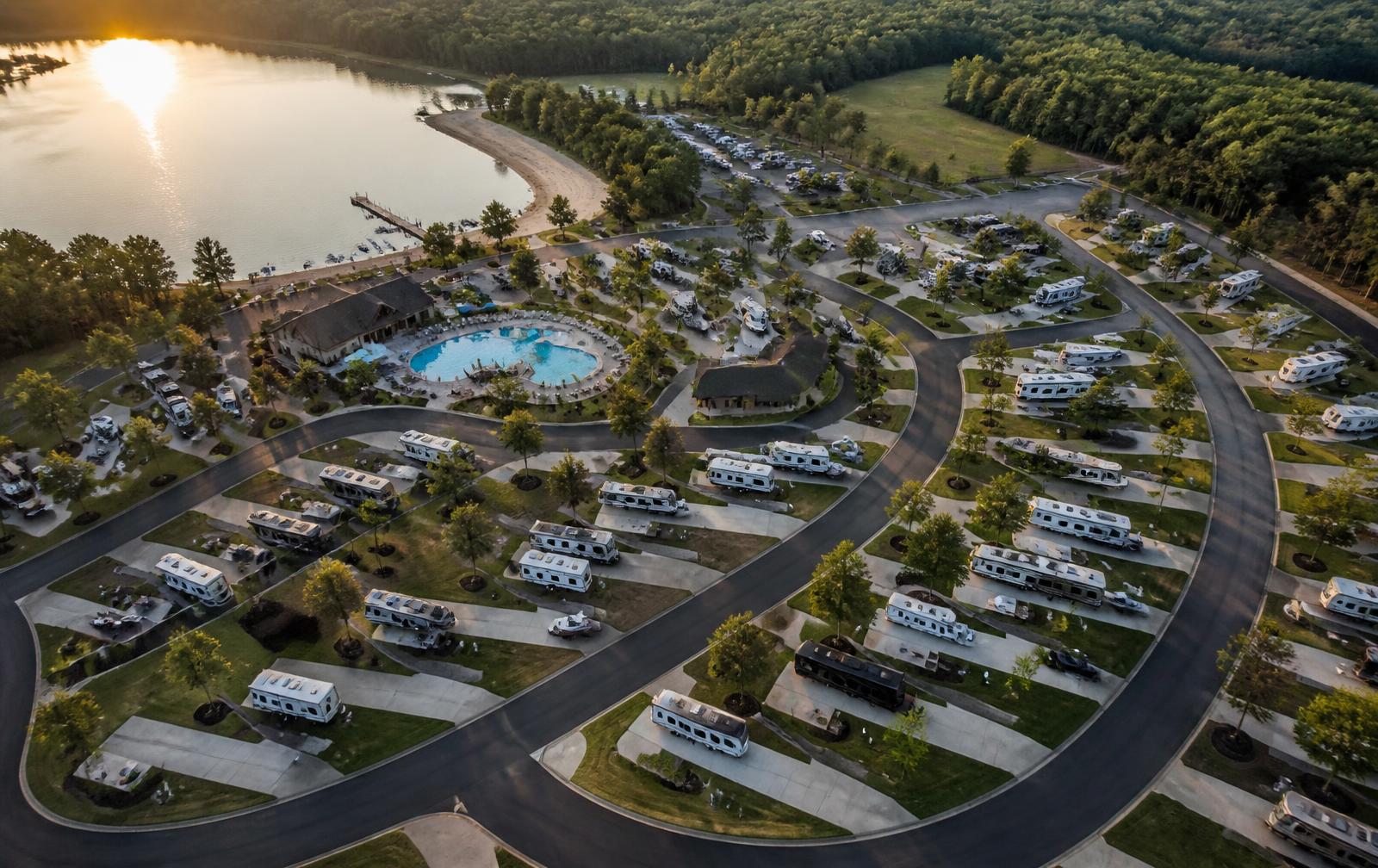
There is no single per-site number for building an RV park. Cost is set mostly by what the land forces you to do before a single RV arrives: how far utilities have to be brought, how much earth has to move, what the local authority requires, and how many usable sites the land actually yields. Two properties bought for the same price can differ by a wide margin on build cost for those reasons alone.
What actually drives the cost
- Land and its shape
- Purchase price matters less than usability. Slope, floodplain, wetlands, rock, tree cover, frontage and setbacks all decide how much of the acreage becomes rentable site.
- Utilities and distance to them
- Water, sewer, and power are frequently the largest single variable. On-site well and wastewater treatment change the budget in a different way than tying into municipal service a mile away. Electrical service capacity for 50-amp pedestals is its own line item.
- Earthwork, drainage and roads
- Grading, stormwater management and road base scale with topography. A flat, well-drained site and a rolling wooded site are not the same project.
- Site count and yield
- The number of sites the layout produces spreads every fixed cost. A layout that finds additional usable sites without hurting guest experience changes the whole pro forma.
- Site type and finish
- Back-in gravel sites, pull-through paved sites, patios, full hookups, landscaping and privacy screening sit at very different price points and support very different nightly rates.
- Amenities
- Pool, clubhouse, bathhouse, laundry, playground, pickleball, dog park, event lawn. Amenities are usually where budgets overrun, because they are chosen by preference rather than by what the rate can carry.
- Soft costs
- Survey, geotechnical work, civil engineering, architecture, permitting, impact fees, legal, financing costs and contingency. These are routinely underestimated by first-time developers.
- Where you are building
- Regional labor and material pricing, permitting timelines and jurisdictional requirements move the number materially between states.
Why per-site rules of thumb mislead
A per-site figure borrowed from another project silently imports that project's land, its utility distances, its site mix and its amenity package. Change any one of those and the number is wrong — often badly enough to break financing.
The more useful exercise is to work the problem from the other direction: establish what nightly rate and occupancy the market will genuinely support, then determine what total development cost that revenue can service. That gives you a build budget the property can actually carry, rather than a budget you hope it can.
The order that keeps cost under control
- Test the market and the achievable rate before committing to the land.
- Masterplan the site to find real yield, with utilities and grading intent considered as part of the layout, not after it.
- Price the plan, then value engineer it against the rate the market supports.
- Take the priced plan into civil engineering and permitting.
- Build to the plan that was underwritten, with cost challenged as it goes.
The most common budget mistakes
- Buying land before testing whether it yields enough sites to work.
- Designing amenities to taste rather than to what the achievable rate supports.
- Treating civil engineering as the planning step, which produces a code-compliant layout that leaves revenue on the table.
- Leaving no contingency for utilities, rock or drainage surprises.
- Phasing badly, so early revenue cannot carry the next phase.
Common questions
Is it cheaper to buy an existing RV park than to build one?
Sometimes, and an existing park comes with a proven revenue history rather than a projection. But an acquisition carries its own risks — deferred maintenance, undersized utilities, a layout that limits rate, or a rent roll that will not survive new management. That is what acquisition due diligence exists to test.
How many acres do I need for an RV park?
Acreage matters far less than usable acreage. Slope, drainage, setbacks, tree cover and required buffers decide how much of a parcel becomes rentable site. A site-yield study on the specific parcel answers this question properly; general acreage-per-site figures do not.
What is usually the biggest single cost?
On most projects it is infrastructure — utilities, earthwork, drainage and roads — rather than the visible amenities. This is also the part of the budget most often underestimated, because it is not what people picture when they imagine the finished park.
Can RDBA give me a cost estimate for my site?
Yes, as part of a feasibility and financial strategy engagement, where the estimate is built from your actual land, layout and market rather than from an industry average. Ron D. Beard has planned, built and operated these properties, so the cost side and the revenue side are tested together.
How RDBA Outdoor Consulting helps
Keep reading
Next step
Get an experienced outside view of the whole project.
Before you buy, build, expand or invest more into an underperforming property, talk it through with someone who has planned, built and operated these businesses.