
Feasibility
RV Park Feasibility Study: What It Covers and When You Need One
A feasibility study is worth commissioning for one reason: it is far cheaper to find out on paper that a project does not work. The studies that are worth their fee state their assumptions openly and show where the plan breaks.
The short answer
An RV park feasibility study tests whether a specific piece of land, in a specific market, can support the site count, nightly rate, occupancy and debt a project would carry. A complete one combines a market and competitive review, a site-yield assessment, a development cost view, and a multi-year pro forma with its assumptions stated plainly enough to be argued with.
What a complete study includes
- Market and competitive review
- Demand drivers, seasonality, travel patterns, nearby supply, what competitors charge and where they are full or weak. This sets the achievable rate and occupancy the rest of the model depends on.
- Site yield assessment
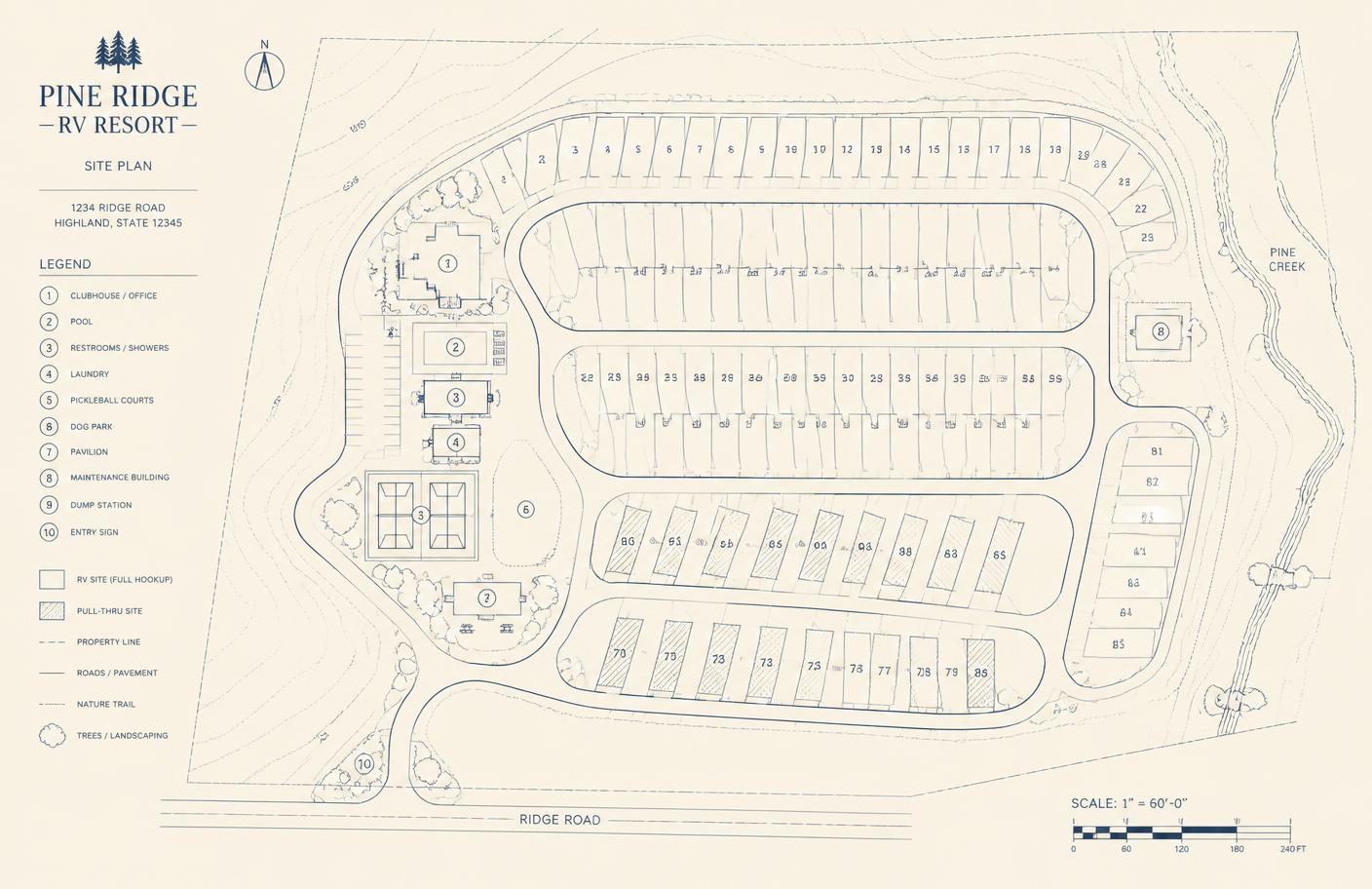
- How many usable sites the land actually produces once slope, drainage, setbacks, buffers, roads and amenity area are honored — and what mix of site types it supports.
- Development cost view
- Infrastructure, utilities, earthwork, roads, sites, amenity buildings and soft costs, built from the specific site rather than from an industry average.
- Income and expense analysis
- Revenue by site type and season, plus a realistic operating expense structure including staffing, utilities, maintenance, marketing and reserves.
- Pro forma and business plan
- A six-year plan with rate, occupancy and expense assumptions stated openly, suitable for lender and investor review.
- Sensitivity and risk
- What happens if occupancy is lower, the season shorter, rate softer or construction cost higher. This is the section that tells you how much room the project has.
When to commission one
- While land is under contract, inside the due-diligence period.
- Before civil engineering is drawn, so the layout can still change cheaply.
- Before an expansion or a new phase at an existing property.
- Before approaching a lender or investors, who will ask these questions anyway.
What separates a useful study from a filed one
A study written by someone who has only modeled these properties will produce defensible spreadsheets. A study written by someone who has planned, built and operated them will also catch the things that do not appear in a spreadsheet: a layout that will not accommodate a big rig, a utility run that will blow the budget, an amenity package that cannot be staffed, a rate assumption the guest experience will not support.
Ron D. Beard is an architect, developer and operator with more than three decades focused on outdoor hospitality and hundreds of projects consulted on. That is why RDBA's feasibility work carries the design and the operations view alongside the numbers.
What the answer can be
Sometimes it is yes, at this site count and this rate. Sometimes it is yes, but not as drawn — a different mix, a different phasing, a different amenity package. And sometimes it is no, which is the most valuable answer a feasibility study can deliver, because it arrives before the money does.
Common questions
How is a feasibility study different from a market study?
A market study tells you about demand. A feasibility study takes demand and tests it against your specific site, its yield, its development cost and its debt — so it can conclude whether the project works, not just whether the market is healthy.
Will a lender accept a feasibility study?
Lenders want to see the market view, the cost view and a multi-year pro forma with assumptions they can interrogate. RDBA builds feasibility work as a six-year business plan intended for exactly that review.
Do I need one for a small park?
The stakes scale with your exposure, not with the site count. Small projects usually have less margin for a wrong assumption, so the risk of skipping the analysis can be higher, not lower.
What if I already own the land?
Then the study focuses on yield, phasing and positioning: what this land can support and in what order to build it. That is often where the largest value is found, because layout decisions still control both cost and revenue.
How RDBA Outdoor Consulting helps
Keep reading
Next step
Get an experienced outside view of the whole project.
Before you buy, build, expand or invest more into an underperforming property, talk it through with someone who has planned, built and operated these businesses.